

The Swedish band Enforcer (active since 2004) has made a name for itself over its 20-year history, not only for its prominence in the Swedish metal scene but also internationally. One of the keys to Enforcer’s success lies in their playing of a style that, for some, seems to have risen from the dead, although it’s clear it never truly disappeared and is unlikely to: Heavy Metal. What must be acknowledged is that these days, it’s not very common to find bands that embrace this genre, let alone do so with such outstanding skill.
Enforcer, just arrived from their recent participation in the Greek Mediterranean Metal Cruise where they shared the bill with their compatriots Bullet, Dream Evil and Legion Of The Damned among others; and taking advantage of the fact that they will soon be landing in Spanish lands on a three-day tour organized by Manguales EMU, V’N’MATW contacts them through their leader Olof Wikstrand to tell us some secrets that have made them so triumphant.
K: First of all, thank you so much for taking the time to answer the questions on my VALENCIA’N’METAL AROUND THE WORLD website.
A month and a half ago, you were on tour for twenty days supporting the Italian band Rhapsody of Fire on their American tour. How was the experience? Had you previously coincided with RoF in some festival, or was this the first time?
Olof Wikstrand: The experience touring with Rhapsody of Fire was absolutely amazing. To be honest with you, a little bit embarrassing, perhaps, but I’ve never heard Rhapsody before this tour. I just heard the name. And we never met them either, but we got super well along together. We had a great load of fun together and we had it was an incredibly, great tour. I mean, in the United States, I think that these type of tours work better than in Europe, people in the United States are a little bit more generally into Metal and not so niched and specific about what kind of Metal they like as we are in Europe.
K: It’s a very interesting thought, one that has often crossed my mind… Considering that Enforcer is already a veteran band when it comes to large-scale tours, as you rightly said, from your experience, are there any notable differences between American and European promoters?
Olof Wikstrand: Yes. I think that’s the biggest difference between American European, maybe not promoters, but the crowds. The American crowds are much more accepting to differences within the Metal genre. I think it’s both a good and a bad thing perhaps that Europe is extremely niched. It’s easy to connect with the audience within a niche, but it’s also really, really hard to the time that you want to do something slightly different or you get very, very judged from not fitting exactly into the box. So, yeah, that’s I would say that’s the biggest difference, you know, there are like people who can come out to our shows in like in Slipknot, Ghost and, you know, new Metal stuff and still be excited about seeing us at the same time as there are people in shirts that resonate more with our type of music also and they all get well along together.
K: I completely agree. There’s a lot of intolerance within the Metal scene. Enforcer will begin a tour of Spain next Wednesday, November 12th, to celebrate your twentieth anniversary. This tour will include Madrid, Valencia, and Barcelona. Have you played in Spain before? Of the three cities, are there any you haven’t played in yet?
Olof Wikstrand: Yes, many, many times. I think we never played in Valencia, though, but we played Madrid in Barcelona countless of times. One of our first shows outside of Sweden was in in Murcia, in Spain. Got a lot of friends around there and we were very early on connected with the metal scene in that part of Spain. First time I think must have been in 2008 already. So that’s a long time ago, 17 years ago.
K: And is it exciting for you to be able to bring your music to new cities? What can we expect the people which never see you before at an Enforcer show?
Olof Wikstrand: I think it’s very exciting to come to places we’ve never been before and to connect with the scene in in every city. I want Enforcer to be the household name of metal in every city of the world. What we are, you can expect the people. I think that we deliver a quality show. We have six albums out now and we do kind of the best of. So, you know, I think that both the songs stand out and also we like focus that we have is always to deliver a big show and like an insane energy. I think that’s what differs us to a lot of other balances that we do this 100%, you know, in every aspect of a Metal show music, energy, stage performance, everything. I think it’s something that makes Enforcer standout from other bands for sure.
K: We’re really looking forward to your show on November 13th in Valencia. Something that struck me the first time I heard you was that Enforcer’s style is rooted in classic 80s-style Heavy Metal with Speed Metal influences, something quite unusual these days. Was there something that made you choose this particular genre, or was it something that came naturally?
Olof Wikstrand: I don’t think I ever chose to play music in this genre. I just like Metal. I’m grown up with Metal and I’m you know ever since I was a kid, that’s been the only thing in my life. I don’t think that Enforcer is retrograded ‘80 Heavy Metal. It’s just that I dislike so to, so to speak, modern Metal, I refuse to acknowledge anything after ‘95 and Purely Metal. So, you know, it’s for me, I’’s completely normal and natural to play like what you would call Old School. For me is just Metal.
K: You used the word ‘Retro’, a term I’ve seen used to describe you before, and from your tone, I gather you are not entirely happy with it…
Olof Wikstrand: I don’t think that we play retro. I think that Enforcer is the most modern band in the world. We play Metal the way we think it should sound and that’s about it, you know? More, you know, I don’t think that. You know, screaming and trigger drums and, you know, it’s scooped guitar tones and all that shit. I don’t think that’s Metal. To me, that’s not even Metal, you know. So this is just purely what I’m interested in and I don’t see anything else.
K: It’s a very interesting point, and one I’d honestly never considered. We all know the importance of the Swedish School to the Metal world, and it’s well known for having influenced other, more extreme genres, with illustrious names like Dark Funeral, Watain, Dissection, Opeth… So, is it difficult to carve out a niche in a scene seemingly closed to more classic styles while defending such a traditional style as yours, or is that a subjective matter?
Olof Wikstrand: It’s the same thing there, you know. I know these bands. I’ve been listening to them at times in my life, perhaps, but I honestly, I don’t think about him, you know? These other type of Extreme Metal and things that have been happening after the ‘90s has it doesn’t do me anything. It’s just like radio music, it goes in and one ear and out through the other. There are, however, some exceptions of stuff that I’ve been listening to in my childhood, like Watain and Dissection. Out of these bands that you mentioned, I can still go back to for a nostalgic reasons, but I’m really not interested in the Extreme Metal whatsoever to be honest with you.
K: I understand. Are there other bands in Sweden that are in your style? Do you know if they formed after your presence and advocacy for this genre in the scene, or were there already some before?
Olof Wikstrand: Yes, there are a bunch of bands in Sweden. I think the New Wave of Traditional Heavy Metal, if you choose to call it this way, started a lot in Sweden with bands such as Bullet (Editor’s note: Bullet visited SPN, specifically VLC, where we witnessed their set in 2014, accompanied by Stallion and Striker), Us, and A Portrait, and also In Solitude (Editor’s note: currently disbanded) and Helvetest Port, who spearheaded the authentic metal revival in the 2000s. These bands, especially in their time, connected strongly, played together, and built the entire scene. We brought young people back to traditional Metal, something that first happened in Sweden and then spread to other countries, like Spain, also as well. And we later connected with these scenes, you know, in in the world. And later, I was an ambush also, they came a few years later, but they were also doing this, and they still do.

Enforcer. 2025 (photo taken from their official IG)
K: In Enforcer’s sound, I’ve noticed that, although you’re indebted to the typical Old School Heavy sound, as we’ve already discussed in this interview, you also add a characteristic Scandinavian touch that makes the final result contemporary and fresh. Are you agree or it is just my apreciation? From where do you get your inspiration?
Olof Wikstrand: I’m definitely inspired by Swedish music, and I think that Swedish music in general is has a touch of melancholy to it. We are very good at like minor playing in minor in melodic minor and, you know, just doing sad music in general. And I think that’s where it comes from it, probably, you know, Swedish folk music, tradition or whatever, but it’s a sound that is deeply rooted in all Swedish music, I would say, in a significator of Swedish and Scandinavian music. Perhaps that’s what you are referring to. But, you know, to be honest with you, I don’, when I write songs, I don’t think about metal at all. I’m just focusing on writing the best song that I possibly can, regardless of genre. And I think once you boil it down, you know, it doesn’t matter because a good song can stand on its own. A good song will still be a good song if you make it like a metal production of it or if you do like a stripped down piano vocal version of it, it will still be a good song. So, I try not to focus on so much on the production or the genre itself when I write music, because you know, that’s not, that’s going to take focus away from the actual song crafting. If that makes any sense.
K: I think it makes sense; in fact, it’s a very interesting way of looking at it, and one I’ll keep in mind from now on. We know that nowadays, getting a band to reach a large audience isn’t easy. What do you think has been your formula for success in Enforcer?
Olof Wikstrand: It’s really hard. And I mean, there’s a long discussion I could write the book about a lot of these answers, but I try to keep it short. I think it’s partly because we were first. Maybe we weren’t first, but I think we were the first real metal band in the 2000s to release an album on a semi major label with major distribution. And I think that was what put us ahead of other bands at that time. And, you know, the momentum that we created back then with our two first albums (Into the Night (2008) and Diamonds (2010)) is something that we managed to ride on and to build a career from before any other band started to catch on.
So, we also, like the success of Enforcer has been timing, I would say, but also that we, I think that we make pretty great songs, if you ask me. Also, yeah, I would say that’s probably it. And I mean, then it’s just, we were also like among the first bands to like create the following online. When we released our first stuff back in 2004 or 2005, you know, platforms such as MySpace had just started to come out and break new bounds. So, we have never been, we have never been dependent on record sales, and we were like one of the first bands who got viral on MySpace at that time, and that created a huge load of opportunities for us to work with music in the digital era and the era of music streaming. So that’s, you know, while other bands tried to fight against it and, you know, and go back to and focus on record sales and stuff like that. We’ve never had that focus whatsoever. The only focus that we’ve had is to spread our music as largely as possible. with the tools that are available today, such as YouTube streaming platforms, Spotify, you know, anything so I think that’s that that’s part of the that like the way we’ve been working since very early on also.
K: Adapting and leveraging resources that help you expand is the best way to reach many places and listeners that would otherwise be very unlikely. Your vision for reach is fantastic. And even with all these tools in your favor, have you ever encountered a hostile audience on a joint tour or at a festival, that is, attendees who are there for another band and are seeing you for the first time? Is it difficult to win over those groups, or do you not think about it?
Olof Wikstrand: Yes, well… we see people all the time that has never seen us before, and I’m, you know, that’s something I think that we should be happy for if it was only the people who have seen us before and the old fans coming out to every show, I think that people will just drop off and drop off as a band, you are very dependent on constantly making new fans because your current fans, you know, you go through faces, you discover different types of music and you’re into different types of music one year and a couple of years later you would be into something else. So, the regrowth of the fan base is constantly like to have that as a constant factor is extremely important for a band. That’s why it’s really important to always be out there playing the festivals, doing the support tours. You know, just be visible so that new people can discover you and do headline tours and support tours and everything. I think that’s extremely important. And, how is it difficult to win them over? I think, you know, it wasn’t the beginning, but I think, for example, I think we sound better live now than what we’ve ever been before, but that’s also comes with experience. I mean, for every year that we play, we become tighter, better, we play better, we sound better. So I think it’s getting easier and easier. We see a lot of festivals that we do that people, you know, that people react extremely well on our shows. In many occasions. Sometimes it’s hard to come to festivals and play because you’re very limited in what you can do. You know, you have a short line check or like change over and situations are most often extremely stressful playing festivals. So that usually puts you in a situation where you perhaps can’t perform or when you have to perform under stress. But, you know, you just have to do your best and to have you the lowest of your level has to be high, but that comes with experience once again.
K: I completely agree. Enforcer has released six studio albums, the latest being ‘Nostalgia’ in 2024. What were you looking to explore on this album with such an evocative title? What themes do you usually address in Enforcer?
Olof Wikstrand: We’ve released five studio albums. I think it’s actually six studio albums by now. With ‘Nostalgia’, that was, you know, I think, perhaps it was like the song I the song I was, we were most happy with while doing it. And it was also like some of the heavier concepts of the album that we felt could be as a title track and build, you know, somewhat of a concept around with cover artwork and stuff like that. So… but I mean, what it comes from is that, you know, you know, we are almost in our 40s. Now we’ve been doing this for 20 years. Sometimes you just like, stay and reflect a bit on your time and you and you realize that that your time here on Earth isn’t endless. I think you will you will always, you know, start to question that. It’s maybe not so much in your youth, but the older you get, you will definitely see what time does to everything around you.
And about what themes does a forcer usually talk about? I mean, I don’t think there’s any limit in what we write about, but there’s been a lot of horror theme with the band because I’ve kind of been feeling that it’s, you know, puts it puts the music in it in a context a bit. It’s also like a kind of Classic Metal Metal subject. But as most things, you know, I like to use clichés, but clichés with a twist, you know. So, you can still be creative with clichés, I think. If you just don’t use them straight off, but do it with your own touch and it will for the listener, it would be something that they feel comfortable and used to, but when you twist clichés a little bit, you will also be able to create something new out of subjects that’s been used before, but it’s also like a bit a little bit in line with the music and that also, the rest.
K: Reinterpreting clichés is something many don’t usually do, and sometimes the results are quite appealing. And finally, when you finish the tour that will bring you to SPN on November 12th, 13 th and 14th (Editor’s note: plus a fourth date in Marseille on November 15 th) what are your immediate plans: more tours, new music, taking a break…
Olof Wikstrand: Yes! We’re super excited to be coming to Spain. It’s been a long time since we headlined shows in Spain. I think it was in 2022. We played in Madrid and Barcelona. Amazing shows, really. So, I’m hoping this tour will be just as good, or even better. Then we’ll be doing a lot of one-off shows. We’ll be doing some shows in Greece and some in Sweden. Then we’re going on tour in South America next year and we’ll also be playing some festivals in February. We have a lot of recorded material for the future, but you know, we’ve been touring a lot and we’re also trying to keep everything else going at the same time, as it gets harder every year. So we’ll see when a new album comes out, but sooner or later, for sure.
K: If you want to add anything else, go ahead.
Olof Wikstrand: Thank you so much for this interview.
K: To you. Very appreciated.
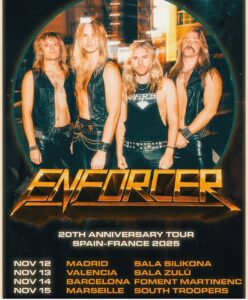
Enforcer’s SPN-FRA Tour 2025
ENFORCER at RRSS
Oficial Site
https://www.enforcerofficial.com/
https://www.instagram.com/enforcerofficial/